






The zip is nearly at the top, the shoes are waiting and you needed to leave five minutes ago. Your child pushes your hand away: “I do it.”
Those determined moments can be inconvenient, but they also show how much being able to do things matters to children. The small movements involved in gripping, turning, pulling and releasing are part of fine motor development.
Fine motor skills help with daily tasks, including eating, dressing, drawing and handling objects. The Victorian Government’s early childhood guidance recognises their role in both self-care and emerging writing. There are plenty of ways to practise without adding a lesson to your day.
Choose a job your child actually wants to do
Start with something that has an appealing result. A child who wants to carry their own snack may be interested in learning how the container opens. Someone planning a teddy picnic might enjoy setting out cups.
Make the first attempt easier. Partly loosen a lid, hold a bag steady or begin the zip before inviting your child to finish. You are giving them a manageable part of the task, then gradually offering more as it becomes comfortable.
Try practising at a quieter time. Saturday afternoon can be a much kinder moment to explore coat fastenings than a busy Monday morning.
Five small invitations for busy hands
Set up a paper repair shop
Give an older toddler or preschooler a large sheet of scrap paper and a few wide paper strips. They can make pretend tickets, tear the strips into shorter pieces or join paper with age-appropriate glue. An adult can prepare any cutting first. The result might be a collage, a road or a very unusual hat.
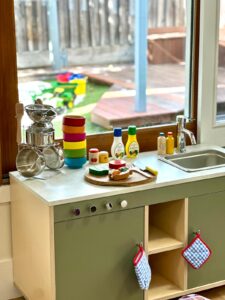
Wash the toy dishes
A damp washcloth and large, unbreakable toy plates can make a satisfying job. Your child can hold a plate with one hand while wiping with the other, then dry it and stack it. A damp cloth on a tray avoids needing a container of standing water.
Build a tiny neighbourhood
Use large, age-appropriate blocks to make houses for soft toys. Offer a simple challenge connected to the story: “The rabbit needs somewhere to sleep.” Let your child decide what to move, stack or rebuild.
Make a packing station
Put out an open bag, a hat, a washcloth and a soft toy. Your child can fold, tuck, pull and unpack. If the bag has a zip, you might hold the opening while they move the tab. Choose bags without long cords or straps.
Draw a route
Spread paper on a stable surface and offer chunky, age-appropriate crayons. Draw your own winding path beside your child’s marks. They might add a tunnel, a roundabout or a place to park. There is no need to correct their grip repeatedly or ask them to trace your line.
Match materials to the child
Look beyond the suggested age and consider what your child currently does with objects. Small beads, buttons, pom-poms and similar items are unsuitable for children who mouth objects. Supervision does not remove a choking hazard; choose larger, suitable materials instead, and consider younger siblings too.
For children ready to explore scissors, use age-appropriate blunt-ended children’s scissors, stay beside them and practise at a table. Start with small snips in a paper edge. Put scissors away afterwards. Tongs should also suit the child’s size and strength, without sharp points or stiff mechanisms that pinch.
Offer the right amount of help
Watch for the moment an interesting challenge becomes exhausting. You might say, “Would you like me to hold it while you pull?” Specific help can keep your child involved.
Notice what worked: “You turned the box around and found the opening.” Avoid comparing siblings or treating writing as the only destination. Being able to manage a favourite toy or help prepare a place at the table is meaningful in its own right.
If hand use seems painful, your child loses an existing skill or everyday tasks remain unusually difficult, speak with your GP or child health nurse. An occupational therapist can advise when further support would be useful.
Helpful reading
- Victorian Government: fine motor development
- ACCC Product Safety: safe play for babies
- Queensland Health: upper limb and fine motor difficulties
Everyday independence is a useful topic to bring to a centre visit. Explore Little Lane centres and talk with the team about your child’s interests and the skills they are practising.